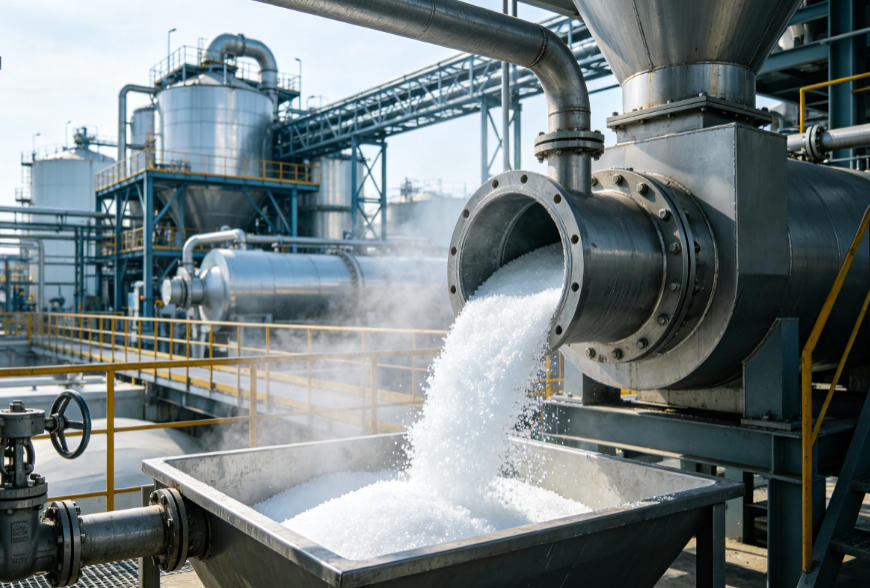
Since 2026, China's caustic soda prills market has shown an overall operating trend of loose supply and demand, low-level volatile prices and differentiated structural upgrading. The industry is in a bottoming-out stage with overcapacity, high inventory and compressed profits. As a core segmented product of solid caustic soda, caustic soda prills are widely used in alumina, papermaking, fine chemical, water treatment and other fields due to their advantages of high purity, convenient storage and transportation, and fast dissolution. Its market trend is deeply bound to the overall cycle of the chlor-alkali industry, downstream rigid consumption and import and export pattern, with obvious phased fluctuation characteristics throughout the year.
From the supply side, the overall production capacity of domestic caustic soda has grown steadily in 2026. Industry data shows that the national total output of caustic soda is expected to reach 41.2 million tons in 2026, a year-on-year increase of 3.4%, among which the total output of solid caustic soda is about 11.75 million tons. As a high-end solid caustic soda product, caustic soda prills have maintained a steady increase in production capacity and operating rate. In the first half of the year, the industrial units operated relatively stably with continuous release of new production capacity. In addition, some enterprises flexibly adjusted production capacity from liquid caustic soda to prills, resulting in sufficient overall market supply. In the third quarter, some chlor-alkali enterprises entered the routine maintenance cycle, leading to a slight contraction of local supply, but the overall overcapacity pattern of the industry has not changed fundamentally, with sufficient market supplies restricting the sharp rise of prices. Meanwhile, the annual global output of chlor-alkali products exceeds 95 million tons, with sufficient international caustic soda prills supplies, and imported supplies further exacerbate the loose domestic market supply.
The demand side is characterized by stable rigid demand, weak incremental growth and structural differentiation. As the largest downstream consumption field of caustic soda prills, the alumina industry has seen the gradual commissioning of new alumina production capacity in Inner Mongolia, Yunnan and other regions in 2026, providing certain rigid demand support. However, the overall operating load of the industry is stable with limited demand increments. Traditional downstream industries such as papermaking, water treatment and textile printing and dyeing have slowed down order growth due to weak recovery of terminal consumption. Purchasing is cautious with a just-in-time procurement mode and no large-scale stockpiling. The demand for high-purity caustic soda prills has grown steadily in high-end downstream fields such as fine chemicals and pharmaceutical intermediates, driving the upgrading of industrial product structure. Nevertheless, the incremental demand in segmented fields is insufficient to reverse the overall weak demand pattern. On the export side, the overall oversupply in the Asian caustic soda prills market and weak overseas demand have led to a slight year-on-year decline in domestic exports in 2026, weakening the driving effect of the external market.
In terms of price trend, the overall price of domestic caustic soda prills has fluctuated at a low level in recent years in 2026, moving in linkage with liquid caustic soda with periodic minor adjustments. In the first half of the year, suppressed by oversupply and weak demand, the price of caustic soda prills continued to operate weakly with the mainstream market price hovering at a low level. In the third quarter, supported by unit maintenance and slight inventory destocking, the price achieved a short-term stable rebound, but the rebound was weak and unsustainable. As of September 2026, the mainstream ex-factory quotation of domestic 99% high-purity caustic soda prills remained at a low level, and the industry as a whole operated with low profits and weak fluctuations. In the international market, the FOB price of overseas 99% caustic soda prills is stable at USD 555-640 per ton. The Asian market is under price pressure with strong price linkage between domestic and foreign markets.
In terms of cost and inventory, the prices of core chlor-alkali raw materials such as electricity and crude salt fluctuated gently in 2026, providing solid cost support for caustic soda prills and restricting the downward price trend with rigid cost constraints, making sharp price declines unlikely. Industrial inventory remained high throughout the year with slow destocking, and the persistent supply-demand mismatch is the core factor suppressing market price recovery. Meanwhile, the co-production characteristics of the chlor-alkali industry are prominent. The synchronous oversupply of liquid caustic soda and prills has put the industry in a phased dilemma of "double losses in chlorine and alkali", compressing enterprise production profits and gradually increasing the willingness of active production reduction.
For the market outlook, in the fourth quarter of 2026, the caustic soda prills market will maintain a trend of low-level fluctuation and weak recovery. With the completion of unit maintenance in the third quarter, market supply will rise again, while downstream terminal demand cannot be boosted rapidly. The loose supply-demand pattern will continue, with low probability of sharp price fluctuations, and the overall price will fluctuate narrowly around the cost line. In the medium and long term, with the sustainable development of domestic high-end manufacturing and fine chemical industries, the rigid demand for high-purity caustic soda prills will increase steadily, and the upgrading trend of industrial product structure is clear. Meanwhile, the continuous elimination of backward industrial production capacity will gradually alleviate the overcapacity problem and optimize the market supply-demand structure. On the whole, the caustic soda prills market will bid farewell to the universal rise and fall model in the future, presenting a structural market of rising prices for high-end products and pressure on ordinary products. Industrial competition will gradually shift from price competition to quality, service and refined competition.