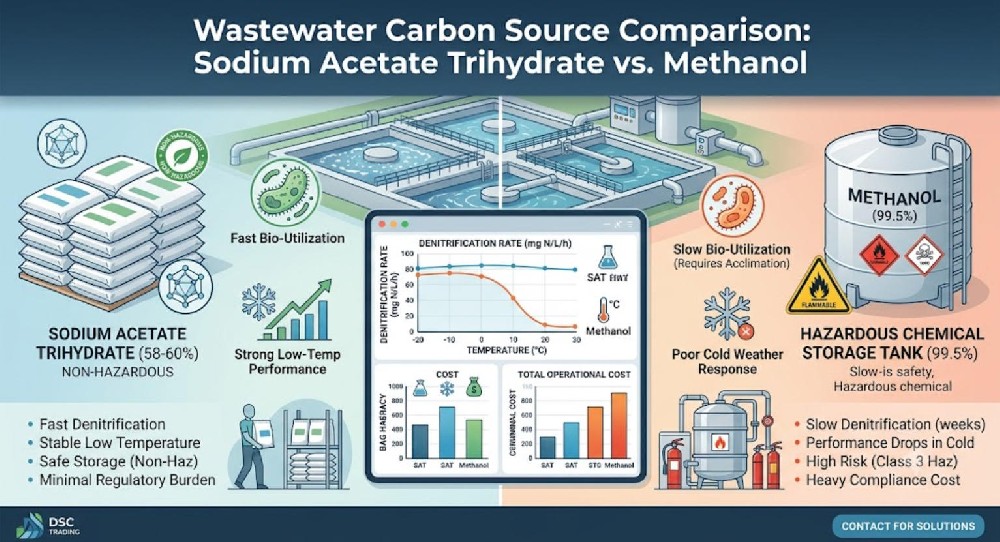
In biological wastewater treatment, particularly during the denitrification process, choosing the right external carbon source is a critical decision for plant managers. For years, Methanol was the go-to choice due to its high carbon density. However, with rising safety regulations and the demand for faster nitrogen removal, Sodium Acetate Trihydrate (58-60%) has emerged as a premium, highly effective alternative.
If you are evaluating Sodium Acetate Trihydrate vs. Methanol, this guide breaks down the real cost-effectiveness, safety risks, and operational performance to help you make the best procurement choice.
1. Denitrification Efficiency: Reaction Speed & Low-Temperature Performance
When evaluating a wastewater carbon source, the speed of nitrate removal ($NO_3^--N$) directly impacts your daily processing capacity.
Sodium Acetate Trihydrate: It is a fast-acting carbon source. Since acetate is a direct precursor in the metabolic pathway of denitrifying bacteria, the microbes can utilize it instantly without any adaptation period.
Methanol: Microbes require an acclimation period (often taking days or weeks) to develop the specific enzymes needed to break down methanol. Furthermore, in cold winter climates, the metabolic rate of methanol-utilizing bacteria drops drastically, leading to potential effluent compliance risks.
Technical Insight: Sodium Acetate Trihydrate maintains excellent denitrification rates even at low temperatures (below $10^circ ext{C}$), making it the ideal choice for wastewater treatment plants (WWTPs) experiencing seasonal temperature drops.
2. Comprehensive Cost Comparison Matrix
While the upfront bulk Sodium Acetate Trihydrate price per ton might seem higher than methanol on a raw weight basis, the total operational cost tells a different story. Below is a comprehensive performance matrix comparing the two:
| Evaluation Metrics | Sodium Acetate Trihydrate (58%−60%) | Methanol (99.5%) |
| Microbial Utilization Speed | Immediate (No acclimation needed) | Slow (Requires weeks of acclimation) |
| Hazardous Classification | Non-Hazardous Substance | Class 3 Flammable & Toxic Liquid |
| Storage & Compliance Cost | Low (Standard warehouse storage) | Extremely High (Explosion-proof tanks, strict permits) |
| Low-Temperature Performance | Excellent & Highly Stable | Poor (Efficiency drops in winter) |
| Sludge Yield ($g ext{ MLVSS}/g ext{ COD}$) | Moderate | Low |
3. Hidden Costs: Safety Regulations and Infrastructure
Many procurement managers overlook the hidden administrative and infrastructural costs associated with hazardous chemicals.
The Hazard Premium of Methanol
Methanol is a highly flammable, volatile, and toxic liquid. Storing bulk methanol requires specialized explosion-proof tanks, advanced fire-extinguishing systems, and continuous environmental monitoring. Additionally, obtaining and maintaining government hazardous chemical permits injects a massive recurring cost into your facility's budget.
The Peace of Mind with Sodium Acetate Trihydrate
As a non-hazardous, crystalline powder, Sodium Acetate Trihydrate is safe to handle, easy to store in standard bags or super sacks, and requires no specialized chemical safety permits. It completely eliminates the risk of workplace chemical accidents and simplifies your supply chain logistics.
4. The Verdict: Which is More Cost-Effective?
If your facility prioritizes low raw material costs and already possesses the heavy infrastructure required for hazardous chemical storage, Methanol remains an option.
However, if your wastewater treatment plant demands strict environmental compliance, rapid nitrogen shock response, stable winter operations, and zero regulatory safety burdens, Sodium Acetate Trihydrate delivers a significantly higher return on investment (ROI). It minimizes operational risks, avoids regulatory fines, and guarantees consistent water quality.
Reliable Sodium Acetate Trihydrate Supply from DSC Trading
As a trusted chemical export trading partner, DSC Trading specializes in delivering high-purity, free-flowing Industrial Grade Sodium Acetate Trihydrate ($58%-60%$) to global markets. We understand the critical nature of international logistics, ensuring moisture-proof packaging and optimal container loading to prevent caking during long-distance ocean freight.
📥 Ready to Optimize Your Wastewater Carbon Source?
Want to check if our specifications match your system? [Click here to request our latest Batch COA & Technical Data Sheet]
Need a competitive quote for your next tender? [Contact our sourcing experts today for a bulk price quotation within 2 hours]