Caustic soda flakes are hygroscopic in a way that actively destroys the product specification. Left exposed to air, the surface layer reacts with atmospheric carbon dioxide to form sodium carbonate. The NaOH content on the certificate was accurate at the factory; what arrives at your plant depends entirely on how the material was stored.
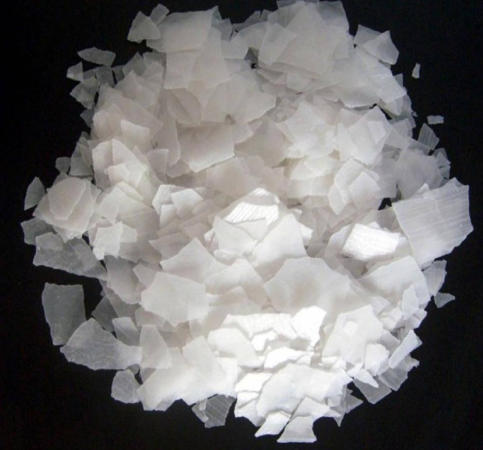
The Carbonation Mechanism
Solid sodium hydroxide draws moisture from the air and dissolves slightly in it, forming a concentrated surface film. Atmospheric CO2 then reacts with that film:
2 NaOH + CO2 → Na2CO3 + H2O
Na2CO3 content therefore rises while NaOH falls. Suppliers quote maximum Na2CO3 limits for exactly this reason — it is both a manufacturing quality indicator and a storage-behaviour indicator. A lot testing close to its ceiling suggests longer product age or imperfect sealing.
Product Identification
- CAS No.: 1310-73-2 | UN Number: UN 1823, Class 8 corrosive
- Alias: sodium hydroxide, lye, flake caustic
- NaOH content: ≥99.0% superior / ≥98.0% first class (GB/T 209-2018)
- Na2CO3: ≤0.5% / ≤0.8% | NaCl: ≤0.03% / ≤0.05%
- Fe2O3: ≤0.005% / ≤0.008% | Appearance: white translucent flakes
- Brands supplied: Zhongtai, Tianye, China Salt, Yuanlong
Main Applications
- Alumina refining: Bayer process digestion of bauxite
- Soap and detergents: saponification of fats and oils
- Textile: mercerisation of cotton for strength and lustre
- Paper and pulp: kraft pulping chemical
- Water treatment: pH correction and neutralisation of acidic effluent
- Petrochemicals: refining and drilling-mud additive
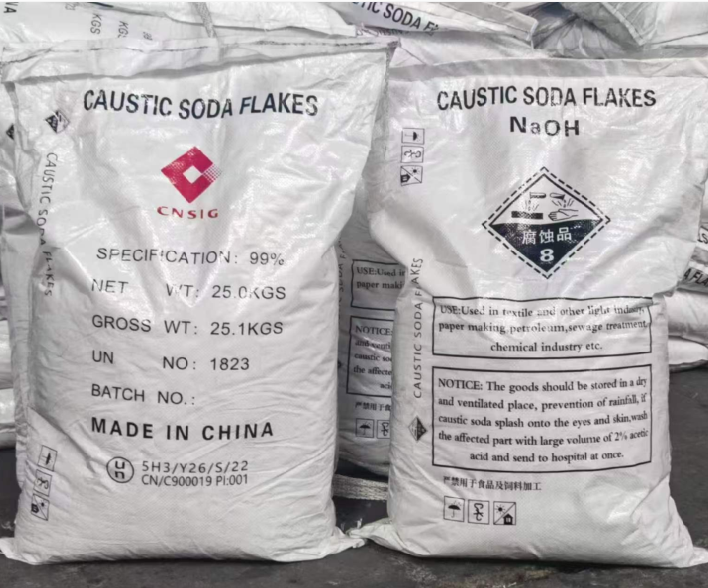
Storage Rules
- Keep packaging hermetically sealed. A re-closable drum with a good gasket is far better than a folded bag.
- Store in dry, well-ventilated conditions away from any water source, including sprinklers and washing areas.
- Segregate from acids, aluminium, zinc and tin — contact generates heat and hydrogen gas.
- Never store ammonium compounds nearby. Combining NaOH with ammonium salts releases ammonia gas.
- Use only dedicated scoops and never return unused material to the original package.
- Dissolve carefully: always add flakes slowly to water, never water onto flakes, since dissolution is strongly exothermic and can splash.
Packaging and Loading
Standard packing is 25 kg bags on moisture-proof, heavy-duty pallets. Loading: 25 MT per 20'FCL without pallets / 23 MT with pallets. For long sea voyages we recommend additional stretch wrapping and encouraged container desiccant use, since every humidity point encountered en route directly reduces usable NaOH.
Shelf Life
24 months in original unopened packaging stored dry. Once opened, use within weeks and re-weigh Na2CO3 if the material will be stored for an extended period before dosing. Personnel handling flakes require gloves, eye protection and face protection — this is a Class 8 corrosive.