Both are the same molecule - sodium hydroxide, CAS 1310-73-2, 99% min purity. Yet plants keep debating flakes versus pearls, because the physical form changes handling, dosing and cost in ways that matter on the ground.
Where the Forms Differ
- Particle behavior: flakes are thin, irregular plates; pearls are dense, uniform micro-spheres. Pearls flow freely and meter cleanly; flakes interlock and can bridge if stored compacted.
- Dust: flakes generate more dust when poured or pneumatically conveyed; pearls are close to dust-free, which matters in automated dosing rooms and near packing lines.
- Dissolution: flakes present a large wetted surface and disperse quickly in agitated make-down tanks; pearls sink and dissolve fast in moving liquor but need circulation to avoid clumping on the tank bottom.
- Moisture pick-up: both are hygroscopic, but the open surface area of flakes makes them cake faster in humid warehouses. Sealed liner bags protect either form.
- Price: pearls typically carry a premium of roughly 5-10% over flakes at equal purity - worth it for dosing automation, not worth it for a manual make-down tank.
Match the Form to the Process
- Choose flakes for saponification kettles, pulp and paper, alumina, textile mercerization and any plant with an operator-supervised dissolution tank - the workhorse choice at the lowest cost per ton.
- Choose pearls for water treatment dosing skids, detergent and soap noodle plants, and any line where the solid must feed a hopper or screw feeder without operator handling.
Container Loading: The Hidden Difference
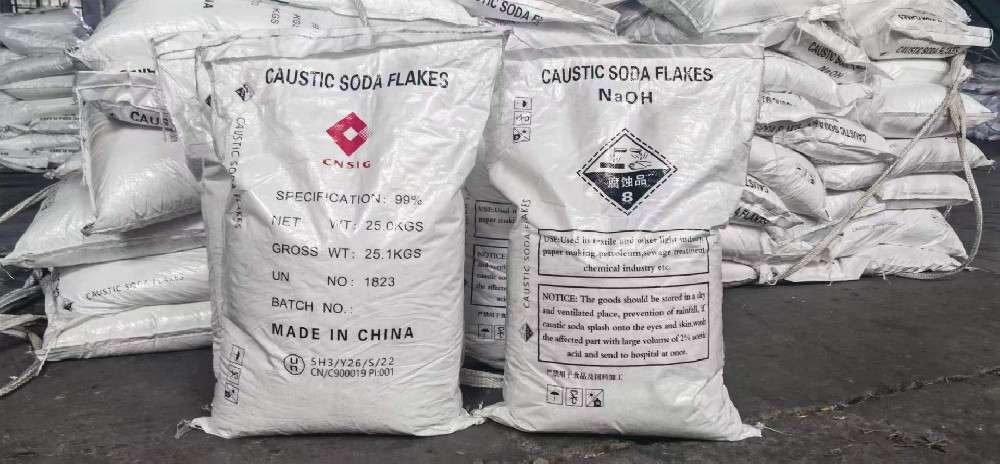
Per 20' FCL, DSC Trading loads 25 MT of flakes (23 MT palletized) in 25 kg three-ply bags, and 27 MT of pearls (25 MT palletized) in 25 kg PP bags. On a full-container basis the pearls option moves more tons - another reason dosing-heavy buyers favor them.
Our Recommendation
We recommend buying both from one supplier so quality tiers stay comparable: DSC Trading supplies 99% min flakes (Zhongtai, Tianye, China Salt and Yuanlong brands) and 99% min pearls (TIANYE brand), each lot SGS-inspected with COA, moisture-proof packing and UN 1823 Class 8 compliant marking. Tell us your application and destination port and we will quote both forms side by side - the final choice becomes a price and handling decision, not a guess. CIF/FOB pricing within 12 hours.

Unsure which form suits your dosing system? Send a photo or datasheet of your feeding equipment and our export team will match the form and packing to it before you order.